Welcome to Xinghua Glass Instrument
How to Select the Right Laboratory Stopper: Glass, PTFE, or Polypropylene?
Selecting the proper stopper for laboratory volumetric flasks and reagent bottles is crucial to maintaining sample integrity, preventing volatile evaporation, and avoiding equipment damage. With several materials available on the market, lab managers must evaluate chemical compatibility, thermal resistance, and operational requirements.

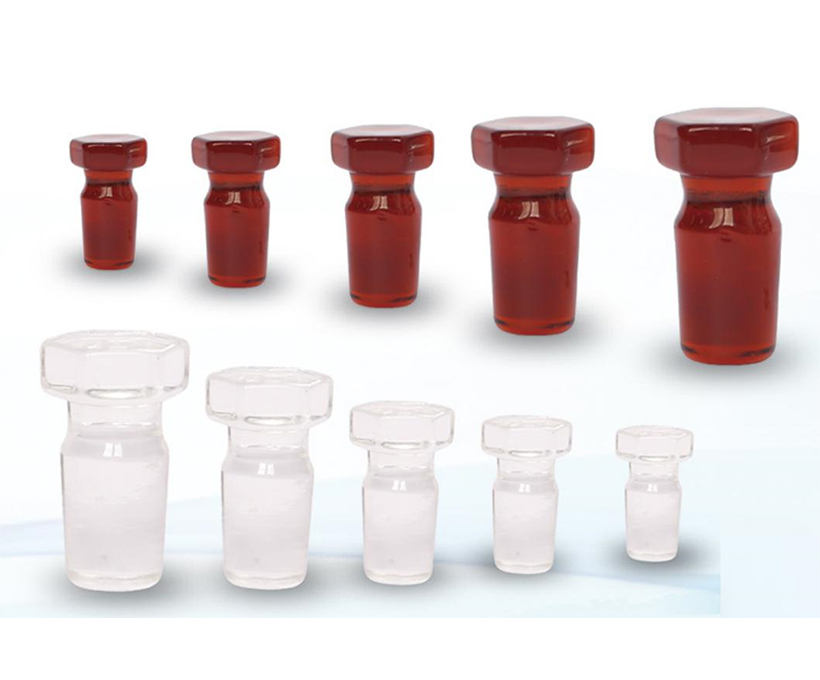
1. Standard Taper Glass Stoppers (Borosilicate 3.3) Glass stoppers provide an ground-joint fit that is ideal for standard analytical storage and volumetric solutions. They offer supreme clarity and chemical inertness against most acids and organic solvents. However, care should be taken when storing strong alkaline solutions to avoid joint freezing.
2. PTFE (Teflon) Taper Stoppers Solid PTFE stoppers are the gold standard for high-corrosion environments. PTFE is completely chemically immune to aggressive acids, bases, and organic solvents. Crucially, PTFE stoppers completely eliminate joint-seizing (“freezing”), making them the safest choice for long-term alkaline storage and high-purity chemical work.
3. Polypropylene (PP) Plastic Stoppers PP stoppers with ergonomic hexagonal heads offer lightweight, shatterproof durability. They protect delicate glass necks from chipping during accidental drops and prevent rolling on lab benches. Fully autoclavable up to 121°C, PP stoppers are an economical choice for high-throughput routine testing.
Understanding these material advantages ensures improved laboratory safety and extended service life for high-precision glassware.